Sectra vs Medicai for Zero-Footprint Diagnostic Viewing
Radiology teams deciding between Sectra and Medicai need a zero-footprint viewer that loads studies in seconds without local installs. Many platforms still require desktop clients or browser plug-ins, which creates access delays for referring physicians and teleradiology coverage.
By the end of this article you will have direct side-by-side data on viewer speed, multi-site routing, and security posture. You will also see clear criteria for choosing Medicai versus Sectra based on your case volume, location count, and compliance requirements.
Quick Verdict: Sectra vs Medicai for Zero-Footprint Diagnostic Viewing
Medicai delivers a HIPAA and GDPR compliant zero-footprint viewer that processed over 300k DICOM visualizations last year, while Sectra offers comparable web-based access for enterprise imaging departments.
Medicai's platform completed 1M+ studies transacted yearly and 50M+ API transactions, demonstrating scale for high-volume image distribution. The solution supports 2M+ imaging studies uploaded and serves 10,000+ active doctors across 70 clinics and hospitals on the platform.
Sectra positions itself as an on-premise or enterprise imaging solution with established deployment models. Healthcare organizations seeking browser-based access often compare both platforms for diagnostic imaging workflows.
Medicai maintains 1.7M+ studies in storage while following OWASP security guidelines. The platform provides FDA/CEE cleared viewers for medical imaging platform requirements.
Research suggests cloud PACS solutions reduce infrastructure overhead compared to traditional on-premise PACS deployments. Medicai's Microsoft Azure partnership supports cross-enterprise access for referring physician portal needs.
Organizations evaluating PACS comparison options should consider deployment models that align with their radiology workflow requirements. Zero-footprint viewer capabilities enable diagnostic imaging access without local software installation.
At a glance: how Medicai compares to Sectra, Medicai for Zero-Footprint Diagnostic Viewing on the features that matter most.
| Feature | Medicai | Sectra | Medicai for Zero-Footprint Diagnostic Viewing |
|---|---|---|---|
| Zero-Footprint Diagnostic Viewing | ✓ | ✓ | ✓ |
What Is Medicai?
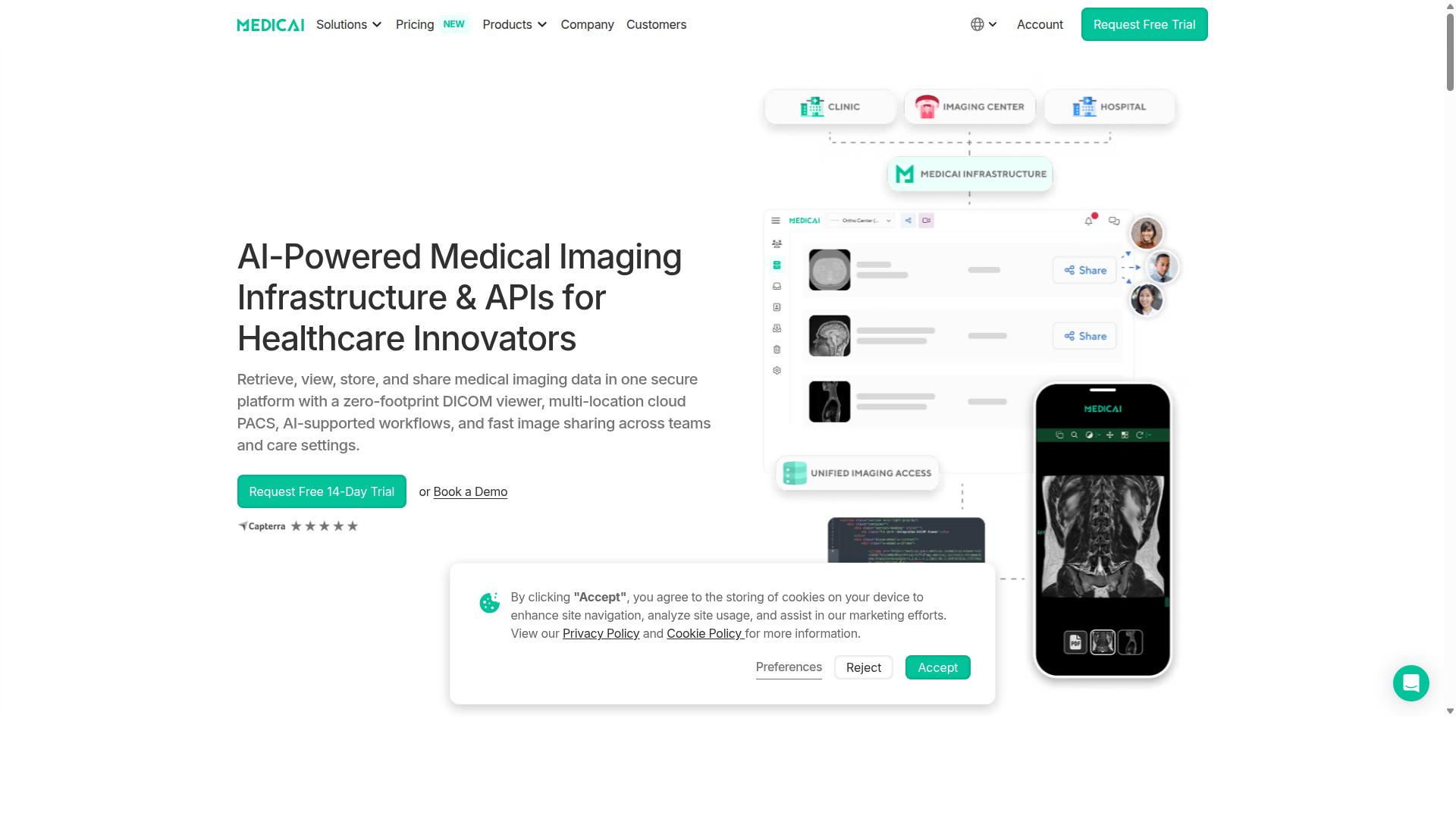
Medicai is a cloud-based medical imaging platform that enables healthcare providers to retrieve, view, store, and share medical imaging data in one secure environment.
The platform includes a zero-footprint DICOM viewer that runs directly in web browsers. This eliminates the need for local software installation or hardware upgrades at clinical sites.
Healthcare organizations use Medicai as a multi-location cloud PACS solution. The system supports image distribution across different facilities while maintaining centralized storage and access controls.
Medicai currently houses over 1.7 million studies in its cloud storage. This capacity demonstrates the platform's ability to handle substantial imaging volumes for enterprise imaging needs.
The solution holds both FDA clearance and CEE certification. These regulatory approvals confirm the platform meets medical device standards for diagnostic imaging use.
Medicai operates as Imaging Infrastructure as a Service. This model allows healthcare providers to access enterprise imaging capabilities without managing on-premise hardware infrastructure.
The platform supports AI-supported workflows that work together with existing radiology processes. These capabilities help streamline image interpretation and reporting tasks.
Image sharing occurs through secure channels that connect care teams across different locations. This supports cross-enterprise access for referring physicians and specialists who need browser-based access to patient studies.
What Is Sectra?
Sectra is a Swedish medical imaging IT company supplying radiology and pathology workflow solutions to hospitals and imaging centers worldwide. The organization has built a reputation over several decades as a provider of on-premise PACS and enterprise imaging systems. Many facilities rely on Sectra products when they need stable local infrastructure for diagnostic imaging.
Traditional deployments often center on servers installed within hospital data centers. These systems handle study storage, image rendering, and workflow orchestration under direct institutional control. IT teams manage hardware maintenance, software updates, and security patches as part of regular operations.
Because the platform runs behind institutional firewalls, on-premise PACS environments can meet strict data residency requirements. Administrators configure role-based access and audit logging locally to align with internal policies. This model provides predictable performance when network conditions remain constant inside the facility.
However, zero-footprint diagnostic viewing introduces different expectations. Clinicians and referring physicians increasingly seek access through standard web browsers without installing client software. Browser-based access demands efficient image distribution across varying network conditions and device types.
Expanding such access often requires additional modules or secure gateways. These components must handle SSL encryption, user authentication, and study loading speed while maintaining HIPAA compliance. Facilities weighing on-premise PACS against cloud PACS options evaluate factors such as maintenance burden, scalability, and cross-enterprise access needs.
What Is Medicai for Zero-Footprint Diagnostic Viewing?
Medicai's zero-footprint viewer loads DICOM studies directly in any modern browser without local software installation or plugin dependencies. This browser-based access eliminates the need for desktop applications or hospital network connections. The platform supports multi-modality studies across radiology and clinical workflows.
Security features include SSL encryption for all data transfers and comprehensive audit logging that tracks user activity. Role-based access controls allow administrators to set permissions based on clinical roles and organizational needs. These measures support compliance requirements in healthcare environments where data protection matters.
The cloud PACS infrastructure handles study storage and retrieval through vendor neutral archive capabilities. Medical imaging exchange features enable secure sharing between facilities. This architecture supports both on-premise PACS and cloud-based deployments depending on institutional requirements.
Medicai recorded over 300,000 visualizations in the past year across its DICOM viewer platform. The system integrates structured reporting for radiology and provides dedicated portals for doctors and patients. API access allows developers to connect existing systems through standard protocols like WADO and HL7 interfaces.
Features Compared
This section contrasts the technical capabilities that matter most for zero-footprint diagnostic viewing workflows.
Three areas stand out when evaluating browser-based platforms. Viewer performance affects daily reading speed. Cloud integration determines how easily multiple sites share studies. Security standards protect patient data across networks.
Each subsection examines these factors using available product information. The comparison focuses on features that directly impact diagnostic workflows and institutional requirements.
Zero-Footprint Viewer Performance & Accessibility
Both platforms emphasize fast image rendering and browser-based access, yet implementation and scalability differ.
Zero-footprint viewers eliminate local software installation. Users access studies through standard web browsers. This approach simplifies deployment across hospital networks and remote reading stations.
Medicai supports 300k+ visualizations of DICOM studies in the last year. The platform processes over 1M+ studies annually. Cross-device compatibility extends to desktop, tablet, and mobile environments.
Sectra offers enterprise imaging solutions with browser access. Specific loading times and compression methods vary by configuration. Performance depends on institutional network infrastructure and study complexity.
Image compression techniques affect transmission speed. Lossless compression maintains diagnostic quality while reducing file sizes. Both platforms support multi-modality imaging across different study types.
Cloud PACS & Multi-Location Integration
Cloud-native architectures enable imaging centers and hospital networks to consolidate studies across sites.
Medicai provides a 2 TB Standard plan supporting one connected location. The platform includes Medical Image Exchange for secure study distribution. Vendor Neutral Archive capabilities allow long-term storage independent of proprietary formats.
Backup and Disaster Recovery services protect against data loss. The Microsoft Azure partnership provides infrastructure reliability. These features support multi-site workflows without traditional hardware investments.
Sectra delivers enterprise imaging integration through established hospital systems. Cloud deployment options exist but typically require custom configuration. Integration scope depends on existing institutional infrastructure and vendor partnerships.
Multi-location access requires consistent user authentication across sites. Role-based permissions control study visibility. Both platforms address these requirements through different architectural approaches.
Security, Compliance & Vendor Neutrality
Data protection and interoperability standards are critical when moving imaging outside institutional firewalls.
Medicai maintains HIPAA and GDPR compliance. The platform holds FDA/CEE cleared viewers. SSL encryption protects data during transmission. Audit logging tracks user access and study interactions.
OWASP security guidelines guide platform development. These standards address common web application vulnerabilities. Compliance certifications reduce institutional validation requirements.
Sectra maintains general compliance posture for healthcare environments. Specific certification details vary by deployment model and regional requirements. Enterprise customers typically require documented security assessments.
Vendor neutrality allows institutions to change systems without data migration issues. Standards-based interfaces support integration with existing hospital information systems. Both platforms address these interoperability needs through established protocols.
Pricing Compared
Transparent subscription tiers help organizations forecast costs for cloud imaging storage and access.
Medicai offers clear monthly pricing that scales with storage needs and deployment complexity. The Starter tier costs $249 per month and includes 500 GB of cloud storage with unlimited user accounts and no connected locations.
The Standard tier costs $749 per month and provides 2 TB of cloud storage with unlimited user accounts and one connected location. Organizations can also opt for yearly billing to receive 15 percent savings on both tiers.
Sectra pricing remains quote-based and varies according to deployment size and infrastructure requirements. This approach requires direct consultation to determine actual costs for specific radiology environments.
Organizations evaluating zero-footprint diagnostic viewing solutions can quickly compare Medicai's published rates against traditional quote-driven models. This direct comparison helps teams understand total cost of ownership for browser-based access to diagnostic imaging without additional hardware investments.
Enterprise customers with multiple locations or external access requirements receive custom pricing that matches their specific diagnostic imaging workflow demands. Per-study pricing options exist for organizations that prefer usage-based billing rather than fixed monthly storage allocations.
Who Should Choose Medicai
Organizations seeking predictable monthly costs and rapid deployment of browser-based diagnostic tools align well with Medicai. The platform serves healthcare providers across multiple specialties without requiring local installations or complex infrastructure.
Hospitals managing high imaging volumes and imaging centers benefit from the zero-footprint viewer capabilities. Cross-enterprise access allows physicians at different locations to review studies without delay or additional software.
Specialty care providers including orthopedics, neurology, oncology, radiology, and cardiology find value in the multi-modality support. These departments often need browser-based access for consultation and treatment planning across multiple patient cases.
Virtual care providers and telemedicine platforms use the system for remote diagnostic viewing. Teleradiology services and tumor boards rely on consistent access to images regardless of participant location.
Medical education organizations and clinical trials benefit from the patient portal features. Personal injury lawyers also access imaging studies securely when reviewing cases that require medical documentation.
Research suggests that organizations handling large annual study volumes gain workflow efficiency through browser-based deployment. The platform supports multiple specialties while maintaining HIPAA compliance standards across all user types.
Who Should Choose Sectra
Large hospital systems with established IT governance and on-premise infrastructure often evaluate Sectra for tightly integrated radiology and pathology workflows.
These organizations typically maintain dedicated server rooms, experienced security teams, and strict data residency requirements. On-premise PACS solutions like Sectra allow complete control over hardware placement and network segmentation.
Institutions that already operate extensive internal networks may prefer this model when regulatory frameworks demand physical isolation. The architecture supports direct integration with existing laboratory information systems and hospital information systems.
Security teams appreciate the ability to manage encryption keys and authentication protocols internally. Role-based access policies can align precisely with internal job functions and departmental boundaries.
Facilities with mature change-management processes often view on-premise deployments as lower risk than cloud transitions. Staff members familiar with local hardware maintenance may find comfort in keeping image archives within facility walls.
Pathology departments that require specialized visualization tools sometimes favor Sectra when microscope integrations already exist. Multi-modality support within a single on-premise environment can reduce the need for separate viewing stations.
However, the trade-off involves ongoing hardware refresh cycles and dedicated IT staffing. Organizations must budget for server upgrades, backup infrastructure, and security patches throughout the system lifecycle.
Cross-enterprise image distribution becomes more complex when external referring physicians need access. Browser-based viewing requires additional VPN configurations or dedicated remote access solutions.
Research suggests many health systems eventually seek hybrid approaches that combine on-premise archives with cloud-based distribution layers. This evolution often stems from growing demands for mobile diagnostic viewing and referring physician portal access.
Who Should Choose Medicai for Zero-Footprint Diagnostic Viewing
Specialist groups needing immediate referring-physician access through any web browser benefit from Medicai's architecture. The zero-footprint viewer eliminates local installations while maintaining full diagnostic quality across remote locations.
Referring physician portals allow external care teams to view studies without separate software. This setup reduces delays in care coordination and keeps all parties aligned on treatment planning from the first review.
Mobile diagnostic viewing extends the same capabilities to tablets and smartphones. Clinicians can review images during rounds or between appointments without sacrificing image quality or security standards.
HL7 and FHIR integration connects Medicai with existing hospital systems. The Doctor Imaging Portal and Patient Imaging Portal work together to distribute studies across the entire care continuum.
Cloud PACS capabilities and the Vendor Neutral Archive support enterprise imaging strategies. Organizations gain centralized storage while maintaining compatibility with multiple modalities and vendor systems.
Medical image exchange features allow secure sharing between institutions. The platform supports teleradiology workflows and tumor board presentations without requiring additional infrastructure investments.
Teams evaluating PACS comparison options often prioritize browser-based access. Medicai delivers this capability through its DICOM Viewer and Medicai Imaging API while maintaining compliance with healthcare data standards.
Structured reporting tools complement the viewing experience. Radiologists can generate reports directly within the platform and share findings with referring physicians in a consistent format.
Final Verdict
Choice between Sectra and Medicai hinges on deployment model preference, budget predictability, and the need for immediate browser-based access. Organizations that favor cloud infrastructure and transparent pricing models find Medicai more aligned with their operational needs.
Medicai's zero-footprint viewer eliminates server installations and client-side software requirements. This approach reduces maintenance overhead while enabling immediate diagnostic imaging access across multiple locations.
With 50M+ yearly API transactions, Medicai demonstrates proven scalability for high-volume environments. The platform handles substantial workloads without compromising performance or requiring infrastructure expansion.
Transparent pricing structures support budget planning for healthcare organizations. This clarity contrasts with traditional enterprise imaging solutions that often involve complex licensing arrangements and hidden costs.
Sectra remains viable for facilities preferring on-premise enterprise imaging. Organizations with strict data residency requirements or existing server infrastructure may benefit from this established approach.
Medicai USA operates from 7901 4th St N, STE 300, St. Petersburg, FL, 33702, with phone support at +1 (832) 220 1035. Medicai Romania maintains offices at 53-55 N Filipescu, 5th Floor, Sector 2, Bucharest, 020961, reachable at +40 316 305 875. Contact [email protected] to discuss specific deployment requirements.
Recommended Resources: